Putting Alignment Drills at Home: 5 Drills That Work
Five putting alignment drills you can do at home with a yardstick, mirror, and two tees, with rep counts and real one-putt stats from member rounds.
By Flighting Editorial Team Updated
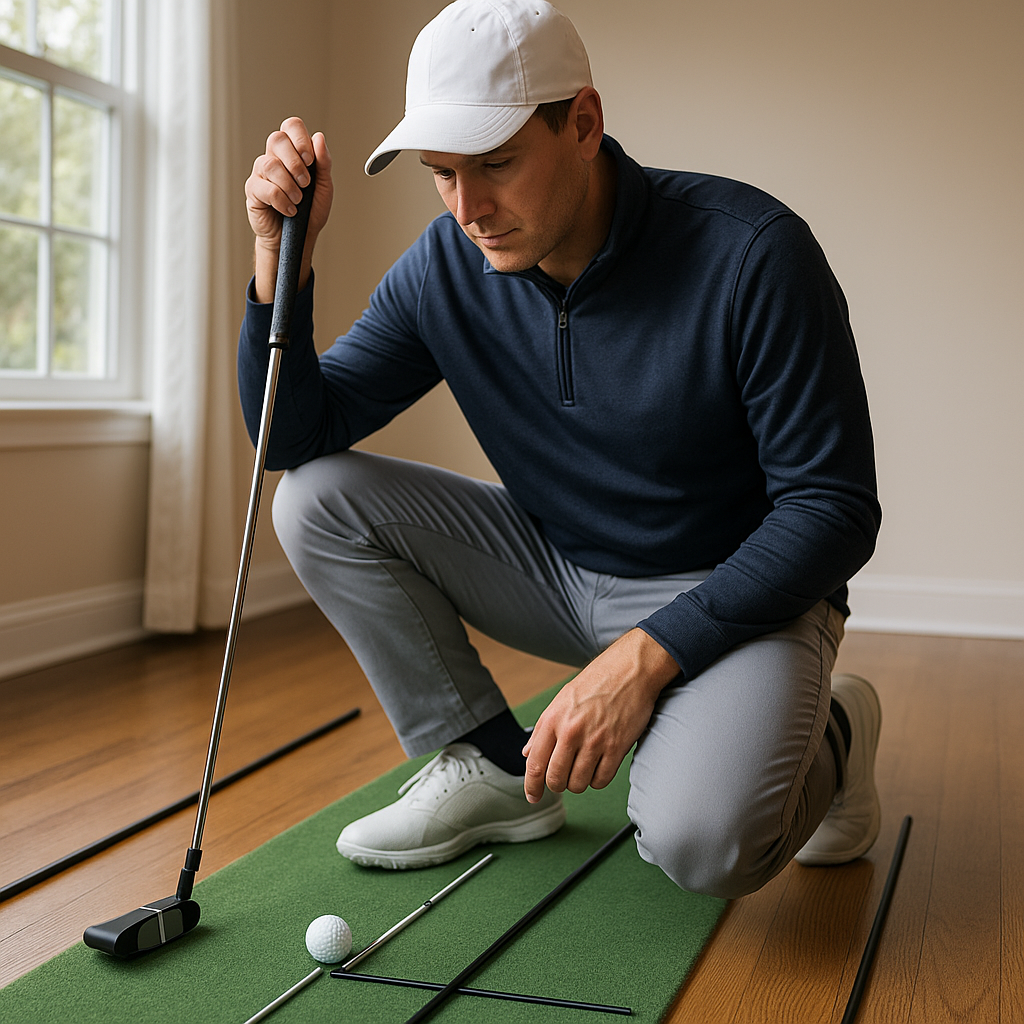
Key Takeaways
- Check three things at home: where the putter face aims, where your eyes sit, and whether the stroke path matches the face.
- A yardstick, a mirror, two tees, and a coin cover every alignment drill in this guide.
- Across 1,786 Flighting member rounds, rounds under 80 averaged 5.41 one-putts; rounds of 95 and up averaged 2.79.
- Ten to fifteen minutes, four days a week, with a set rep count beats one long session on the weekend.
The best putting alignment drills at home check your putter face, your eye position, and your stroke path. Use a yardstick as a track to square the face, a mirror to set your eyes over the ball, and a tee gate to prove the ball starts on line. Ten to fifteen focused minutes, four days a week, is enough to change how you start putts.
How do you check your putting alignment at home?
Alignment in putting comes down to three questions, and you can answer all of them on a living room floor.
- Where does the face aim? The face angle at impact decides most of where a putt starts. A stroke can be smooth and still miss if the face points an inch left of the target at address.
- Where are your eyes? Your eyes should sit over the ball or just inside it, on the target side of your toes. Eyes outside the ball line tend to make players aim right, and eyes well inside tend to make them aim left.
- Does the path match the face? If you aim square but swing across the line, the ball will start off line or skid with sidespin.
Test your aim first, before you drill anything. Set up to a target on the carpet 8 feet away, a chair leg or a coin. Hold your setup and have someone lay a yardstick against the face, or set a laser pointer or a straight edge flush with it. If you've never checked, don't assume you aim straight. Knowing which way you miss tells you which drills matter most.
What are the best putting alignment drills at home?
These five drills build on each other. Start with the first two for a week, then add the rest.
1. Yardstick track (3 sets of 10)
Lay a yardstick or a straight board flat on the carpet. Set a ball on one end and set your putter face exactly perpendicular to the stick, using the edge as a reference. Roll the ball along the length of the stick without it falling off. Do 3 sets of 10. If the ball falls off to one side, your face is open or closed at impact; if it wobbles off near the far end, the ball probably started with sidespin from an across-the-line path.
2. Mirror setup check (10 setups)
Put a small mirror flat on the floor with a ball on the center line. Take your normal setup and look down. Your eyes should appear directly over the ball in the mirror, or slightly inside it. Also check your shoulders: a line across them should run parallel to your target line, not open to it. Step away and set up again 10 times, checking each time without adjusting before you look. The goal is a setup you can repeat without the mirror.
3. Tee gate (make 20 in a row through)
Push two tees into the carpet, or set two coins, just wider than the ball, 12 inches in front of it on your line. Roll putts through the gate without touching either side. Once you can get 20 in a row through, narrow the gate so there is barely a ball's width of room, or move it to 18 inches. This proves your start line, which is what alignment actually buys you.
4. Coin target (10 putts at 3 feet, 10 at 6 feet)
Place a coin on the carpet as your target. From 3 feet, roll 10 putts and count how many stop on or touch the coin line. Repeat from 6 feet. A small target forces precise aim, so a real hole on the course looks bigger.
5. String line (5 minutes)
Tie a string between two pencils pushed into thick carpet, or between two chair legs, a couple of inches off the floor. Set up so the ball sits under the string. Watch the putter head move under it for a few strokes, then look at the ball and roll it. The string shows whether your stroke drifts across the line during the backstroke or follow-through.
How do you practice putting on carpet at home?
Carpet is usually slower and flatter than a green, so it's good for aim and start line and poor for speed. Use that. At home, work on the parts that don't depend on pace: face aim, eye position, start line, and a repeatable setup. Leave long lag putts and green reading for the practice green, where our guide to reading greens like a pro picks up.
A few carpet habits help:
- Use a firm, low-pile rug or a putting mat. Thick carpet makes the ball hop and hides alignment problems.
- Keep putts short. Most of your home work should be inside 8 feet, where alignment decides make or miss.
- Use a line on the ball. Set it down pointing at your target and watch whether it rolls end over end. A wobbling line means the face or path is off.
- Putt to a target with no backstop some of the time, so you still feel a pace that would finish just past the hole.
How do you know if your putter face is square?
Three simple checks tell you more than feel ever will.
- The aim test. Set up to a target 8 feet away, hold still, and have a friend lay a straight edge against the face or look down the line from behind. Repeat 5 times. If you miss the same way every time, that's your aim tendency.
- The line on the ball. Roll 10 putts on a flat floor with the ball's line pointed at the target. If the line rolls end over end, the face was square at impact. If it tumbles or tilts, it wasn't.
- The gate from 6 feet. Set a gate with one ball-width of room 12 inches ahead. If you can't get 7 of 10 through, work on the yardstick track before anything else.
If you consistently aim one way even after a week of drills, the putter itself may be the problem. A different alignment line, a different head shape, or a length that lets your eyes sit over the ball can make square easier to see. Try a few before you buy.
Do better alignment and more one-putts lower your score?
We looked at 1,786 rounds from 228 Flighting members that have putts recorded on every hole, grouped by the round's score. It's the same data set and filters as our Golf by the Numbers stats page.
| 18-hole score | Members | Rounds | Putts per round | One-putts per round | Three-putts per round | Rounds with no three-putt |
|---|---|---|---|---|---|---|
| Under 80 | 156 | 882 | 31.1 | 5.41 | 0.87 | 47.2% |
| 80 to 84 | 125 | 460 | 32.9 | 4.33 | 1.46 | 27.2% |
| 85 to 89 | 87 | 236 | 33.9 | 3.72 | 1.86 | 19.1% |
| 90 to 94 | 56 | 135 | 35.2 | 3.27 | 2.53 | 9.6% |
| 95 and up | 33 | 73 | 37.0 | 2.79 | 3.75 | 4.1% |
Rounds under 80 averaged 5.41 one-putts. Rounds of 95 and up averaged 2.79. Part of that gap is better approach shots leaving shorter putts, so this table doesn't prove alignment alone makes the difference. What it does show is how much weight short putts carry. Going from 3 one-putts a round to 5 is two strokes, and a lot of one-putts are the short and mid-range putts you can train on carpet. To check whether putting is really where your strokes go, split your card with the method in our strokes gained guide for amateurs.
The three-putt column matters too. Nearly half of rounds under 80 had no three-putt at all. A clean start line on the second putt, the 3 to 5 footer after a lag, is where a lot of those three-putts are born or saved.
How often should you practice putting at home?
Short and frequent works better than long and rare. A plan that fits most weeks:
- Monday: Aim test (5 setups), then yardstick track, 3 sets of 10.
- Tuesday: Mirror check (10 setups), then tee gate until you get 20 in a row through.
- Thursday: Coin target, 10 putts at 3 feet and 10 at 6 feet. Write down the counts.
- Friday: String line for 5 minutes, then 20 putts through a narrow gate as a test.
That's about 15 minutes a day. Keep a simple count for each drill so you can see progress week to week, and fit it into a broader weekly practice plan. Then check the result where it counts. Logging putts on each hole in Flighting shows whether your one-putts and three-putts are actually moving over a couple of months. To see what a good total looks like at your level, compare it with our breakdown of how many putts per round is good by handicap.
Frequently Asked Questions
How far should my eyes be over the ball when putting?
Your eyes should be directly over the ball or slightly inside it, toward your feet. A mirror on the floor is the easiest way to check, and it takes about a minute.
Can you really improve putting at home on carpet?
Yes, for aim, start line, and setup. Carpet is too slow and flat to teach speed or green reading, so pair home drills with time on a real practice green.
What is the best putting alignment drill?
The tee gate drill, because it tests the thing alignment is for: starting the ball on your line. If you can roll 20 in a row through a gate one ball-width wide at 12 inches, your face and path are working.
Why do I keep aiming my putter to the right?
Common causes are eyes sitting outside the ball line, shoulders open to the target, or a putter whose alignment aid doesn't suit your eye. Check your eyes with a mirror and your shoulders with a club across them before changing equipment.
How many one-putts per round is good?
Among Flighting members, rounds under 80 averaged 5.41 one-putts and rounds from 85 to 89 averaged 3.72, based on 1,786 rounds with putts on every hole. Adding even one more one-putt per round is a stroke saved.
Join Flighting to track your rounds and unlock rewards.